If your child is in Class 11 or 12, you have probably already been told to start building a profile. Coaching centres say it. School counsellors say it. Cousins who went abroad definitely say it. What almost nobody explains is what that profile is supposed to physically be, or who is meant to look at it.
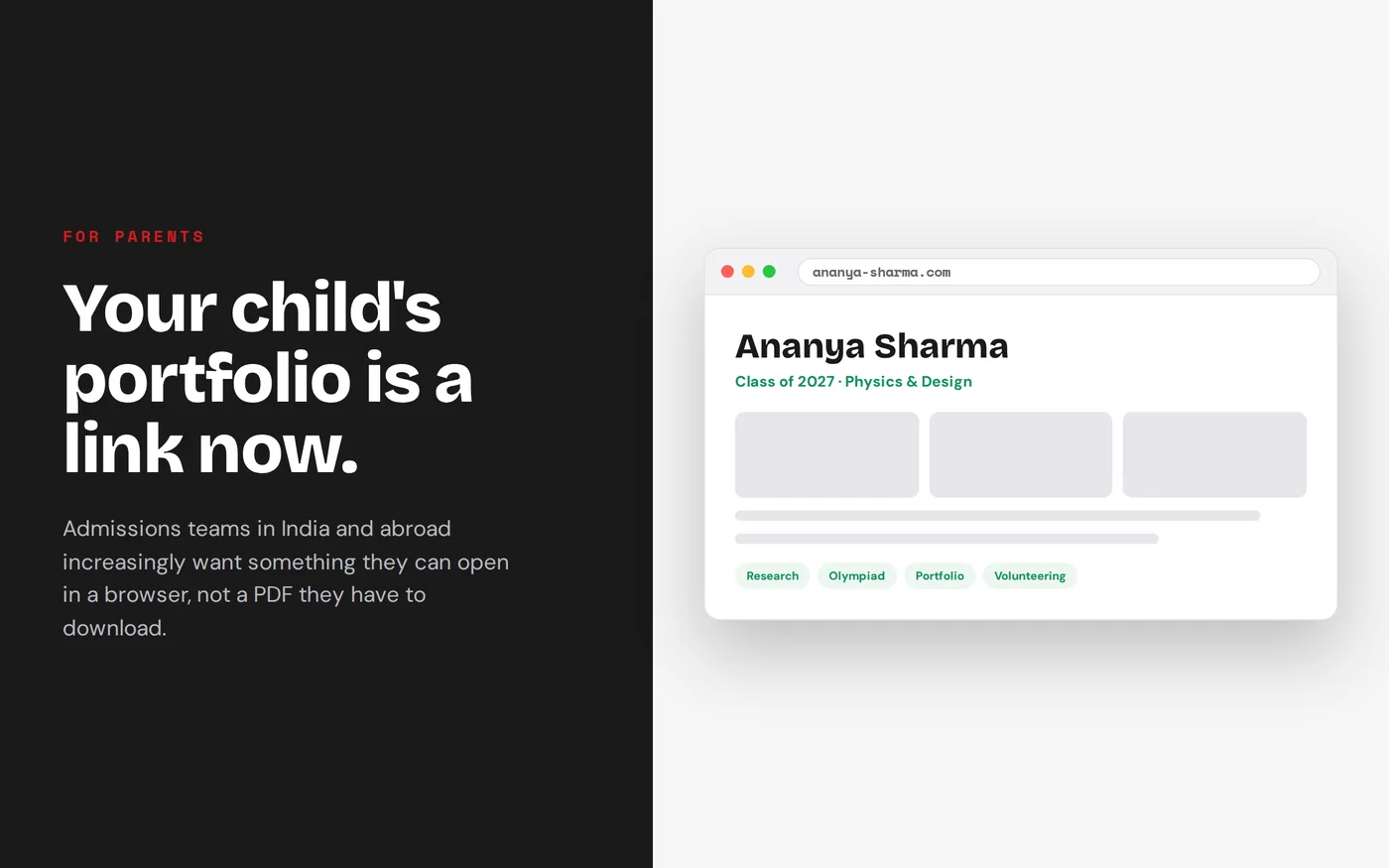
Here is the practical version. A student portfolio is a small website with your child's name on it, holding their work, their results and their interests in one place. You send one link. Whoever opens it sees everything, on any device, in about four seconds.
Why the PDF stopped being enough
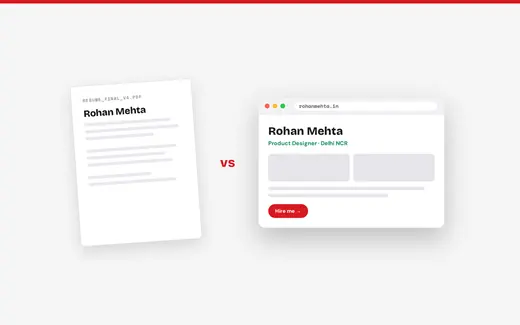
A CV was designed for a world where someone printed it. It carries text well and nothing else. The moment your child's strongest evidence is a science project, a short film, an art series, a piece of code or a recorded performance, the document fails. You end up attaching six files to an email and hoping somebody opens the third one.
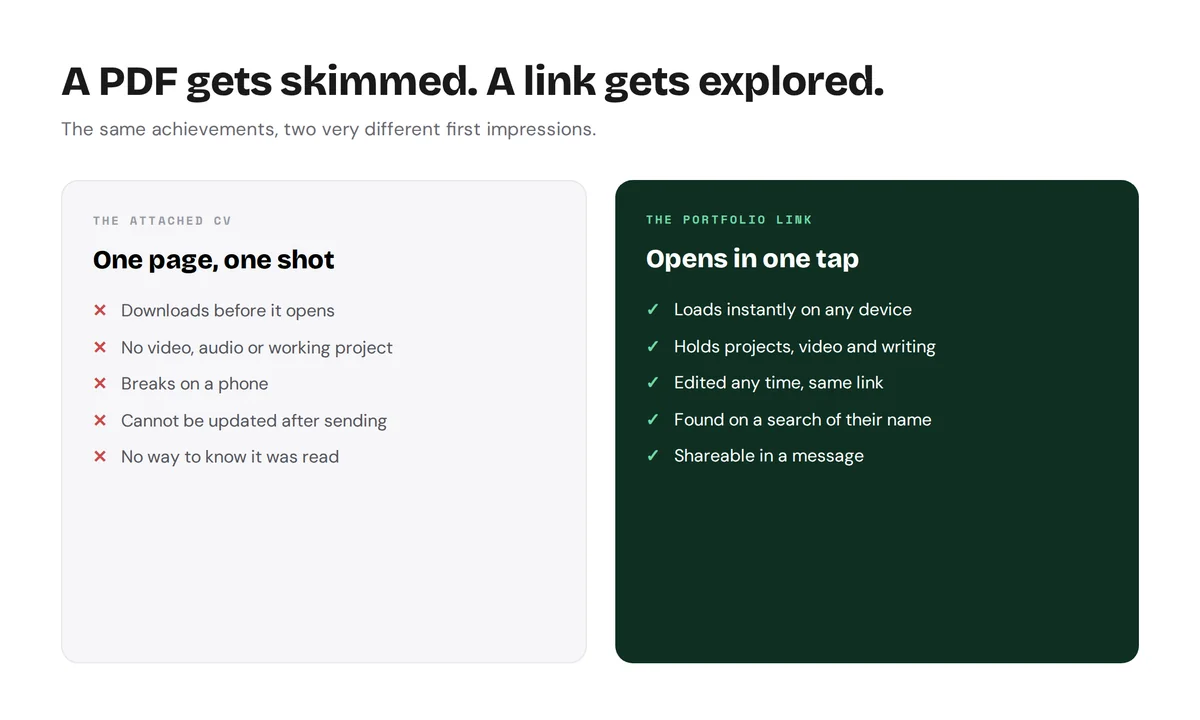
There is a second reason, and it is the one parents underestimate. Admissions officers, scholarship committees and internship coordinators look people up. When they search your child's name and find nothing, that is a neutral result at best. When they find a clean page with the work on it, your child has already answered the question everyone else is still writing an essay about.
Indian universities are catching up fast
Portfolio-based review used to be a foreign-application concern. It is not anymore. Design, architecture, liberal arts, media and increasingly business programmes in India now ask for supporting work, and the ones that do not ask still read it when it is offered. A link costs your child nothing to include.
What actually goes on it
The most common mistake is treating it as a scrapbook. Every certificate since Class 6, forty photos, no structure. An admissions reader gives it under a minute. Structure is the entire job.
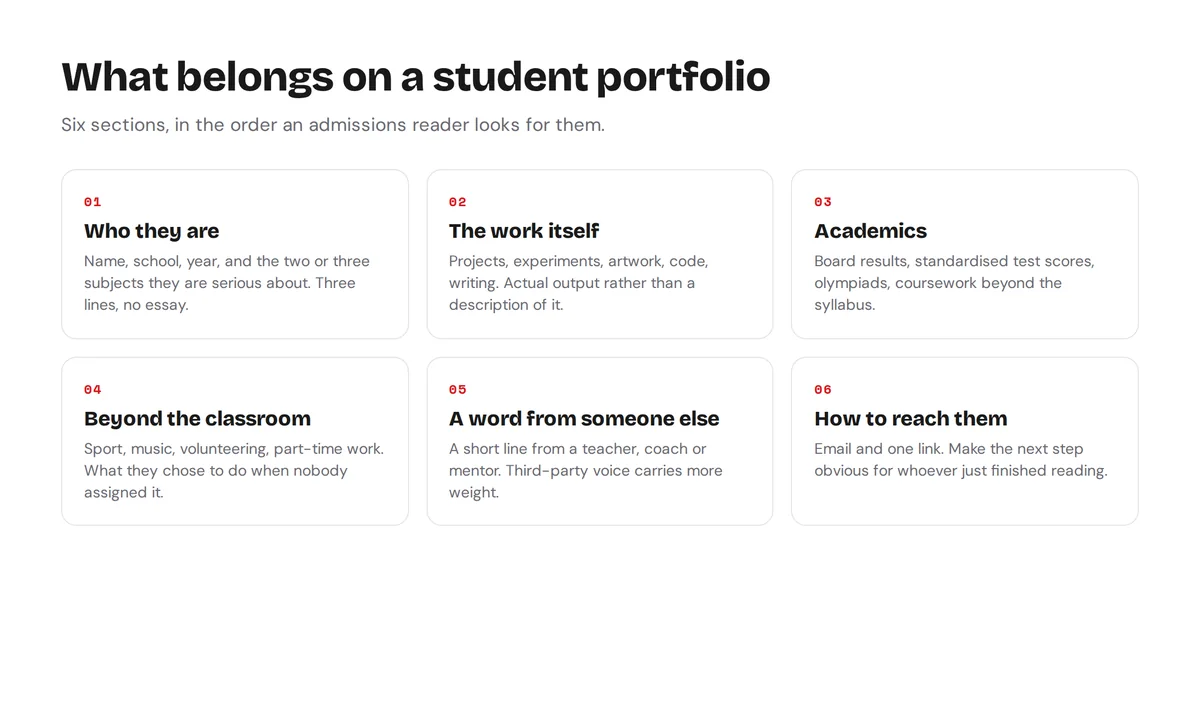
A few things worth insisting on, from the sites we have built for students:
- Use the child's real name as the web address. It is what people will search.
- Show the work, do not describe it. One embedded video beats a paragraph about the video.
- Put a date on everything. Growth between Class 9 and Class 12 is itself the argument.
- Keep it to one page if the material is thin. A short honest page reads better than a padded one.
- Leave room to add. The site should still be useful in the second year of college.
The part parents actually ask about
Two questions come up every single time.
Will it look like the parent made it? That is a real risk, and it is mostly about voice. The writing should sound like a seventeen-year-old who is serious, not like a LinkedIn profile. We usually ask the student to write the first draft themselves and then tidy it, rather than the other way around.
Is this just a vanity project? Fair question. It becomes one if it is built and forgotten. It stops being one the moment it goes into the actual applications, the internship emails, the scholarship forms and the summer programme enquiries. The link is the point. A site nobody sends is a site nobody sees.
We build student portfolio sites
A clean one-page portfolio starts at ₹2,999, with domain registration and setup at ₹2,000, so roughly ₹5,000 all in. Larger multi-section sites for design and arts applicants start at ₹5,999. Built in three to five days, on your child's own domain.
When to start
Earlier than you think, and for an unglamorous reason. Building it forces the inventory. Sitting down to fill six sections is when families discover the certificate nobody scanned, the project that was never photographed, and the teacher who would have written a line if asked in time.
Class 11 is comfortable. Early Class 12 is workable. The week before a deadline is when you find out what was never documented.
If you are weighing it up, the honest test is this. Search your child's name right now, the way a stranger on an admissions panel would. Whatever comes back is currently their portfolio. The only question is whether you would like a say in it.